
PROJECT HIGHLIGHT: Thinking Outside the Box for Rural FTTH Success
February 10, 2026

SUMMARY:
CHALLENGE:
Overcome strict deployment guidelines and unknown legacy conduit conditions to bring FTTH to 17,000 homes in rural Croatia.
SOLUTION:
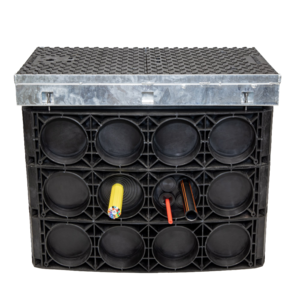
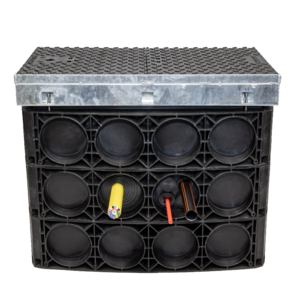
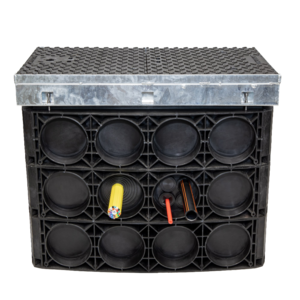
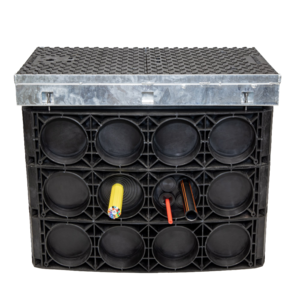
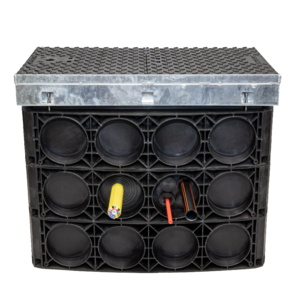
Adoption of modular plastic access chambers, assembled onsite around legacy ducts for seamless integration into the existing network.
RESULTS:
Easier, faster, safer installations, improved installer satisfaction, and greater operational efficiency, with over 700 units installed.
“Here in Croatia, we’re known as innovators,” says Petar Bakota, Project Director at Elektro imber Ltd. “We like to bring new ideas to every project. That’s how we came to use modular plastic chambers in an FTTH network build for the first time.”
A leading telecom infrastructure provider with over a decade supporting Croatia’s major operators, Elektro imber was contracted by A1 Hrvatska to bring gigabitcapable, full-fibre broadband to 17,000 rural homes near Županja, Slavonia, in the east of the country. “We take care of project design, materials, permits, installation, splicing, and quality control,” explains Bakota.
UNIQUE CHALLENGES
Rural FTTH projects are notoriously difficult to deliver on time and to budget, but this one presented additional challenges. “Around half of the funding came from the European Union, and it came with some strict rules,” states Bakota. To minimize cost, disruption, and environmental impact, Elektro imber had to prioritise the reuse of existing poles and ducts, only digging new trenches in places without suitable legacy infrastructure. Where poles were available, Elektro imber pursued aerial deployment. Where they were not, Petar’s team blew or pulled MicroDucts into existing underground ducts belonging to Hrvatski Telekom, part of the Deutsche Telekom Group. They then jetted in micro cables to pass each home quickly and easily.


WHAT LIES BENEATH
With the legacy ducts having been installed decades earlier, when Hrvatski Telekom was still state owned, little was known about their condition. Pre-construction surveys found the conduit to be buried anywhere between one and two metres below the ground, with significant deviation in depth along the same route. “We didn’t know the depth until we started digging,” summarises Bakota. As such, the biggest design challenge came in integrating new access chambers – for cable jetting and the housing of splice closures – into the existing underground network. Historically, Elektro imber had used heavy precast concrete chambers, but with only a limited selection of fixed dimensions available, adapting their old solution to this new application proved too difficult.
INTRODUCING MODULAR PLASTIC CHAMBERS FROM DURA-LINE
When Dura-Line proposed a switch to plastic chambers that could be constructed around the existing ducts with lightweight modular sections, Elektro imber were enthused. Following successful demonstrations, Field Application Engineers from Dura-Line arrived onsite to train installation crews in Slavonia for the first large-scale deployment. Chambers were placed every 150 metres, on average, with each serving eight homes (four to the left and four to the right) via single MicroDucts placed and secured with an end cap until each subscriber took service. Knowing that the height of the chamber could be adjusted with ease, the installation crews simply dug until they reached the legacy ducts then constructed the modular chamber around the existing pathways. And because the chambers were constructed on site, Petar’s technicians were able to save significant time by preinstalling the MicroDucts into the legacy conduits. With a precast concrete chamber, the legacy duct would have needed to be cut prior to placing the chamber, before installing the MicroDucts from hole to hole.


A SCALABLE SOLUTION FOR ANY SITUATION
“Dura-Line’s chambers give us enormous flexibility,” smiles Bakota. Indeed, while most chambers on this project were built with three rings, where the duct was at its deepest, five were used. “We now have a scalable solution for any situation we encounter in the field. So far, all the chambers have been installed in green areas. But, since the chambers are suitable for the D400 loading class, we are also able to put them in pavements and roads if we need to.”
“Using these chambers has given us great benefits in terms of installation, logistics, and transportation,” explains Bakota. Where just one concrete chamber might have fit on a flat-bed van, now a crew can typically carry as many plastic chambers as they need for a day’s work with the same vehicle, thanks to the flat-pack, modular design. And with Elektro imber’s nearest stocking location being up to an hour away from the jobsite in Slavonia, Dura-Line’s chambers delivered dramatic improvements in the overall operational efficiency of the project.
SAFER, HAPPIER PEOPLE
For someone in Bakota’s position, the last and most critical consideration is safety. Elektro imber proudly employs its own installers and the crew on this project had been dispatched over 250 km from their homes in the Croatian capital, Zagreb. “They are our people and we’re responsible for their health and safety,” Bakota says. “Before, when we used concrete chambers, installation was slow and the risk of injury was high. But now, installations are faster, our people are safer, and they are happier too.”
SUCCESS BUILT ON PARTNERSHIP
“We’d had a great relationship with Dura-Line for more than ten years, so we were eager to try their new, modern plastic chambers,” says Bakota. “We respect Dura-Line, and we knew that any kind of support we needed would come. They educated us on how to use the product and sent Field Engineers to work with our people.” “In Županja alone, we used hundreds. Very soon, we might reach one thousand!” he exclaims. “I’m excited to roll this solution out more widely across Croatia on future projects.”
“We’d had a great relationship with Dura-Line for more than ten years, so we were eager to try their new, modern plastic chambers.”
—Petar Bakota, Project Director, Elektro imber Ltd.